
What Is Forest Planning Software in 2026
Forest planning software turns inventory data, growth models, and operating rules into a harvest plan you can defend. If you lead forest planning or operations, you already know where spreadsheets and disconnected systems break down. The plan says one thing. The field does another.
This article explains what forest planning software does, how forestry analytics improve forest management decisions, and what to check before you choose a tool.
Key Takeaways: What Is Forest Planning Software in 2026
-
Forest planning software connects inventory data, growth models, and operating constraints to produce optimized harvest schedules.
-
Forestry analytics let you compare scenarios across timber revenue, carbon, and sustainability goals before you commit.
-
Forestry software adoption usually fails on people, training, and trust before it fails on technology.
-
Clean data links to your GIS, inventory, and ERP systems keep plans and field work in step.
-
Planning teams, field operations, and executives need to be aligned from the start.
What Is Forest Planning Software?
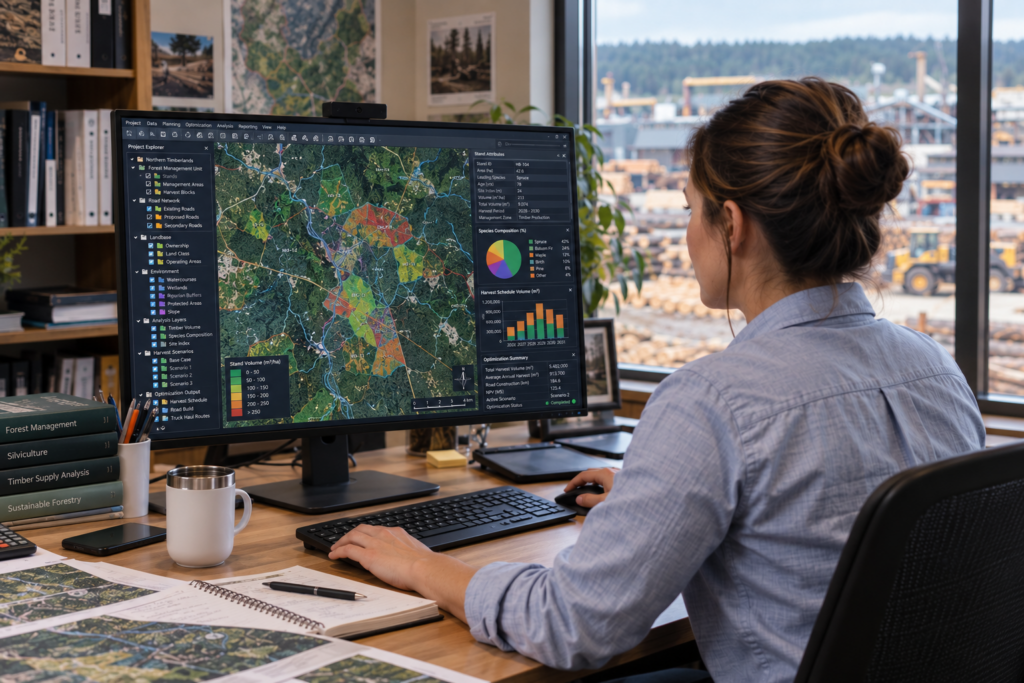
Forest planning software is a specialized tool for modelling, analyzing, and optimizing decisions across your forest assets. It combines spatial inventory data with growth projections, market conditions, and operating constraints to produce a plan you can act on.
Generic analytics tools miss what makes forestry different. Planning horizons run for decades. Trees grow on their own biological schedule. Harvest sequencing follows rules, and regulations change by jurisdiction.
The core job is optimization. It finds the mix of harvest timing, treatments, and logistics that best meets your objectives while respecting your constraints.
How Does Forestry Analytics Improve Long-Term Forest Planning?
Forestry analytics turns raw inventory and operating data into scenarios you can compare before you commit resources. Instead of relying on experience and manual math, you can test thousands of possible strategies over decades.
That matters because forest management decisions compound. A harvest schedule built for short-term revenue can weaken your wood supply ten years later. Analytics shows you that trade-off while you can still change course.
Long-term forest planning works on two horizons. Strategic planning looks 20 to 100 or more years ahead and sets harvest levels, land use, and conservation areas. Tactical planning covers the next 1 to 5 years and turns that strategy into decisions about which areas to harvest, when to build roads, and where crews go. The plan only works when the two stay aligned.
You can also weigh several objectives at once, including timber volume, carbon storage, habitat protection, and certification compliance. And you can see how much of one goal you would give up to gain more of another.
What Forestry Company Challenges Does Forest Planning Software Solve?
Forest planning software closes the gap between the plan and the field. Many forestry companies still plan in spreadsheets and departmental systems that don’t talk to each other. That gap shows up in three ways.
Manual data entry adds errors that build up across planning cycles. Software reduces them.
Long-term plans and weekly schedules drift apart. Software links them, so this week’s harvest decisions support your annual and multi-decade targets.
Replanning is slow. When fire, pests, weather, market swings, or policy changes break your baseline, you need to model alternatives fast and share the new plan across the organization. Good optimization software lets you build those risks into your scenarios up front, so you can test how a strategy holds up before conditions change.
“The ability to have real time, accurate and complete information on all deliveries has significantly changed the way we work, leading to improved decision making and better outcomes for our business, for our suppliers and for our contractors.”
David Poel, Supply Chain Coordinator, Green Triangle Forest Products
In Conclusion: How to Choose Forest Planning Software
Forest planning software moves you from reacting to planning. The right choice links strategy to daily execution, supports scenario analysis for hard trade-offs, and works with the systems you already run.
Pick software built for forestry, not a general analytics tool with a forestry label. Ask each vendor how they handle adoption support, data integration, and model upkeep, not only what’s on the feature list.
Why Does Forestry Software Adoption Fail?
Forestry software adoption fails mostly on people and process, not on features.
The research points the same way. A Forest Research study of decision support tools in Great Britain found that barriers include cultural resistance, low trust between foresters and scientists, a worry that the tools threaten professional judgement, and a lack of training and support. (Forest Research) It’s an older UK study, but the pattern is familiar. If the people who carry out the plan don’t trust it, they work around it.
Skills are part of it too. Tools that demand specialized technical and computing skills are a known barrier to uptake in forestry. (FAO AGRIS) Your planners should be able to run and compare scenarios without waiting on IT or a consultant.
Integration is the other common failure. Your planning software has to exchange data with your GIS, inventory databases, and ERP. Without clean links, you spend more time reconciling data than using it.
What Should You Look for in Forest Planning Software?
Look for software built for forestry, then test it against your own planning complexity. Generic optimization tools lack the harvest scheduling and growth modelling logic that forestry needs.
Forestry logic. Ask how the software handles spatial constraints, long-term forest dynamics, and multi-period optimization across decades.
Scenario work without code. Your planning team should be able to build and compare strategies on its own.
Data links. Confirm it connects to your GIS, inventory, and ERP systems.
Adoption support. Ask how the vendor trains field teams and maintains models after go-live.
Remsoft Planning & Optimization is built on Woodstock Optimization Studio. It connects strategic and tactical planning in a single model, and it ties inventory, operations, and planning together.
How Do Optimization Analytics Differ from Standard Reporting?
Reporting tells you what happened. Optimization tells you what to do next.
Dashboards show current inventory, recent harvest volumes, and delivery performance. They’re good for monitoring. They don’t recommend actions or weigh trade-offs.
Optimization uses mathematical models to test thousands of possible strategies against your objectives and constraints, far more than a planner could by hand. Remsoft uses prescriptive analytics, which goes beyond forecasting to recommend what to do. Because the assumptions and constraints are explicit and can be reproduced, you get a plan you can defend to certification bodies, regulators, and stakeholders.

What Role Does Data Quality Play in Forest Planning?
Your plan is only as good as your data. Incomplete inventory records, outdated growth models, or inconsistent spatial data produce plans that don’t match the field.
Start with three questions. Are your stand boundaries accurate? Are your growth projections calibrated to your forest? Is your operating history stored in a format your planning software can read?
Teams that succeed usually treat data ownership as part of the project. That means clear owners for updates, a way to validate changes, and agreed rules for how systems exchange data. If your inventory needs work first, Remsoft FMS covers LiDAR-enhanced inventory, field data collection, and certification tracking.
Where Do Carbon and Machine Learning Fit in Forest Planning?
Carbon now sits beside timber supply as a planning objective. Recent research builds plans that balance economic value against net carbon sequestration, and it studies the trade-off between the two. (multi-objective forest planning study, 2025) In one strategic planning study, focusing the objective on carbon led to fewer timber harvests. (improved forest management study, 2024) Your software needs to show you that trade-off before you commit.
Researchers are also applying machine learning to forest growth and wildfire risk. In one study of a mixed forest, neural networks and support vector machines predicted 10-year stand volume growth more accurately than linear regression. (Annals of Forest Science) Wildfire prediction relies on machine learning as well as regression methods. (wildfire risk prediction review) These are research results. Ask any vendor which of these methods are built into its planning tools today.
It models and optimizes decisions across your timber assets. It combines inventory data, growth projections, and operating constraints to produce harvest schedules that balance revenue, sustainability, and compliance.
They let you compare strategies before you commit resources. You can test thousands of possible strategies and see how each performs against the objectives and constraints you set.
Mostly people and process: low trust, too little training, and unclear roles between planners and field teams. Weak links to GIS and ERP systems add to it. Success takes change management alongside the technology.
It depends on your data readiness and how complex your organization is. Our team of specialists can walk you through a typical implementation plan.
Yes, if it was built for it. Remsoft’s planning software models carbon sequestration, storage, and emissions alongside timber supply, so you can see the trade-offs between volume, carbon, cost, and constraints in one plan. It can also generate projections for carbon registries and ESG reporting. Remsoft says it cuts the time to run simulations on a new land base from months to days, and that Woodstock is approved by the American Carbon Registry and compliant with other leading standards, including Verra. (Remsoft Planning & Optimization, Remsoft Carbon Management)
Ready to Learn More?
Remsoft builds optimization analytics for the forestry supply chain. To see how Remsoft Planning & Optimization would work with your data, book a demo.