

If you run forest operations, none of this will sound new.
Every machine in your fleet already generates data. Position, production, activity, all of it. Collecting it has never really been the problem. The problem is that the machines work where your network doesn’t. Data sits on a drive in the cab until someone drives out to collect it or the machine finds connectivity again. By the time it reaches anyone who can use it, it’s often stale. You end up managing today’s harvest with last week’s information, and that gap has real consequences for compliance and for cost.
That was the framing Remsoft Product Manager Simon Ketcheson opened with at our recent webinar, and it set up the story that followed. Because this isn’t a data collection problem. It’s a data movement problem, and a data trust problem.
Three things operations leaders ask for
When Remsoft talks to operations leaders, the same three needs come up almost every time. Data people trust, because if the team doesn’t believe it’s accurate and timely, no one uses it. Visibility, so the data shows up where decisions actually get made rather than gathering dust in a report. And control, data used to coordinate what happens next against the forest itself, not just to watch it. Trust, visibility, control. That thread ran through everything the speakers showed next.
A real operation, in the room
Chantiers Chibougamau is a family-owned company established in 1961 in northern Quebec. It has grown from a single sawmill into a large operation running five softwood sawmills and harvesting across 25 forest management units, ten of them FSC-certified, spread across a territory that stretches hundreds of kilometres in every direction. Rapid expansion through acquisition left the company with a familiar problem: multiple operational teams, each carrying its own tracking method, or none at all. Some units used GPS or mapping apps, others nothing consistent. There was no shared standard for data quality, and the processes leaned heavily on manual work. Getting an accurate, timely overview of operations across that territory was genuinely hard.
So they moved. Beginning with a two-machine pilot in 2023, Chantiers Chibougamau rolled out Remsoft Op Tracker to eight machines the following year, then to 38 harvesters across multiple operational units by 2025. This year the rollout is expanding to forwarders and skidders, and notably, that expansion is being requested by the operators themselves.
The part most technology stories skip
That operator detail matters more than it looks. The company’s biggest concern going in wasn’t the technology, it was whether operators would accept it or see it as a surveillance tool rather than a support tool. So the first year set deliberately low expectations: get the system into every machine, capturing tracking data, while minimizing what the operator had to do, and let them get comfortable. The mapping capability, built with LiDAR and satellite imagery to help operators navigate and work safely in the field, is what won them over. Once operators saw it as a genuine aid, they started asking to extend it. As Loydy Brousseau put it, you cannot underestimate the human side of implementing a system like this. Change management is as important as the technology itself.
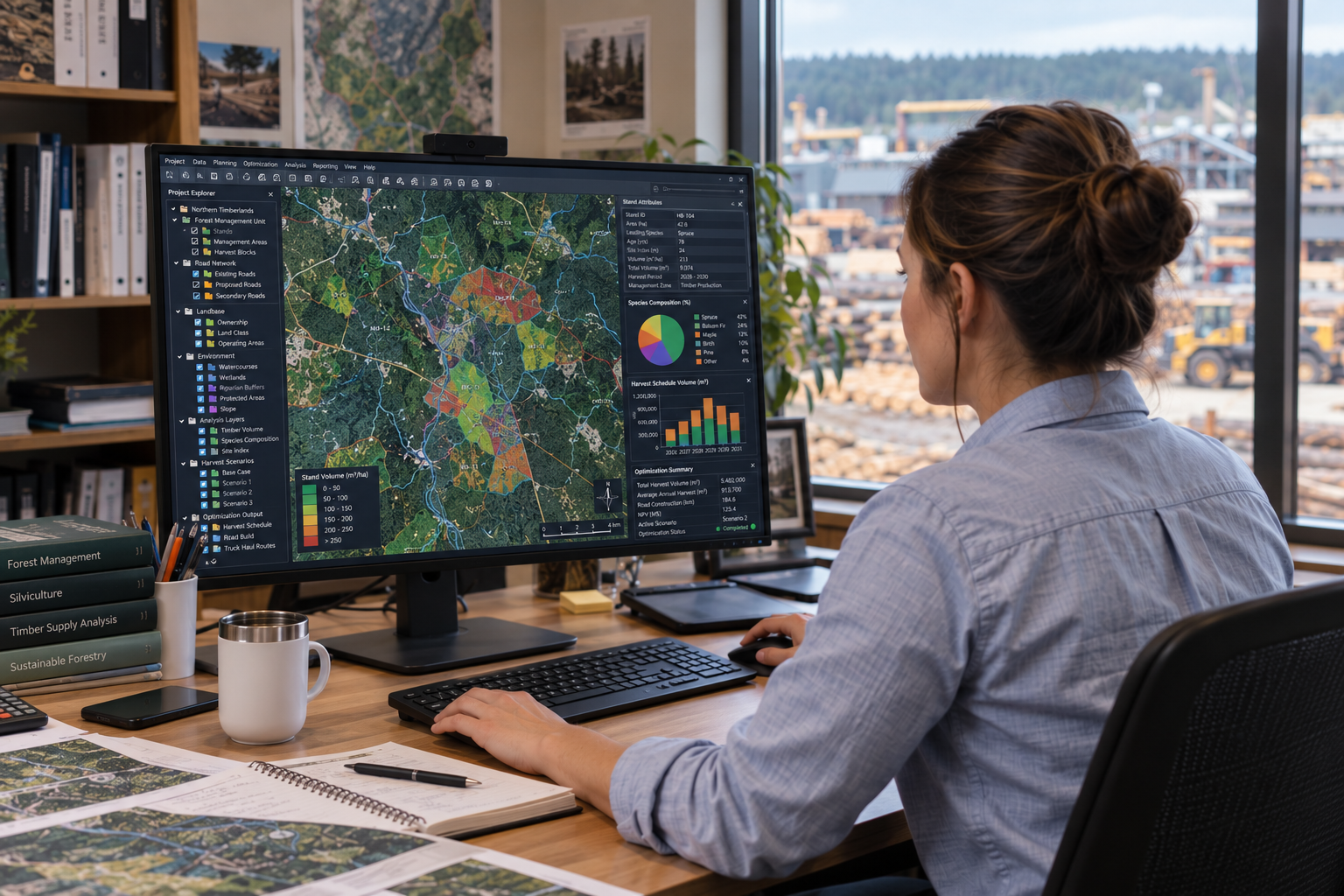
The results he described were about visibility, not vanity metrics. Better compliance and fewer boundary overruns. Near-real-time knowledge of harvest progress, which made it far easier to respond to shifting demand or a mill closure. Easier prediction of when machines would move between blocks, so relocations could be planned. And a shared dashboard, built on standardized data and ArcGIS integration, that cut down the constant phone calls between divisions and supervisors trying to confirm they were all working from the same information.
Technology sharpens judgment, it doesn’t replace it
Op Tracker is machine-agnostic and offline-first by design, built for mixed fleets working where connectivity drops out for days or weeks at a time, syncing when it returns. For teams already in ArcGIS, it runs natively in that environment. But the closing point of the session wasn’t about features. It was that technology doesn’t replace human judgment in the forest. It makes that judgment sharper and faster, by getting what happens in the forest to the person planning the next move, sooner. Operators who started as skeptics ended up asking for more of it. That’s the proof.
See what near-real-time operational visibility would look like across your own fleet.
Book a Remsoft Op Tracker Demo , and we’ll walk through it using scenarios that match your operation.